This guide may contain affiliate links. See our Site Policies for details.
Most people travel with their medication without any problem, but carrying it legally is not just a matter of having a prescription. Authorities overseas can ask you to prove that a medicine is yours, that it was prescribed for you, and that it is allowed in the country you are entering. Every year Australians need consular help because of how they carried or used prescription medicine overseas.
This guide covers what to carry with your medication, how packaging and labels help, how to think about quantity, where the rules are stricter for controlled medicines, and what to know when travelling to or through the United States and the United Kingdom.
A note on what this is: Practical travel guidance, not medical or legal advice. Rules differ by country and change over time. Confirm the requirements for your destination and any transit countries with the relevant embassy, consulate or government website, and speak to your doctor or pharmacist about your specific medication.
Original Packaging and Pharmacy Labels
Keep medication in its original packaging
The pharmacy label is the simplest form of proof that a medicine was prescribed to you. Leave medication in the packaging it was dispensed in, rather than transferring it to a pill organiser or unlabelled container.
Check what the label says
The label should show your full name, the medicine name, the dose, and the prescriber or pharmacy details. The name on your medication should match the name on your passport and travel documents.
Generic names matter
Brand names differ between countries, so a generic (active ingredient) name is more useful to border officials and overseas doctors. If your label shows only a brand name, ask your pharmacist or doctor to help you note the generic name in your paperwork.
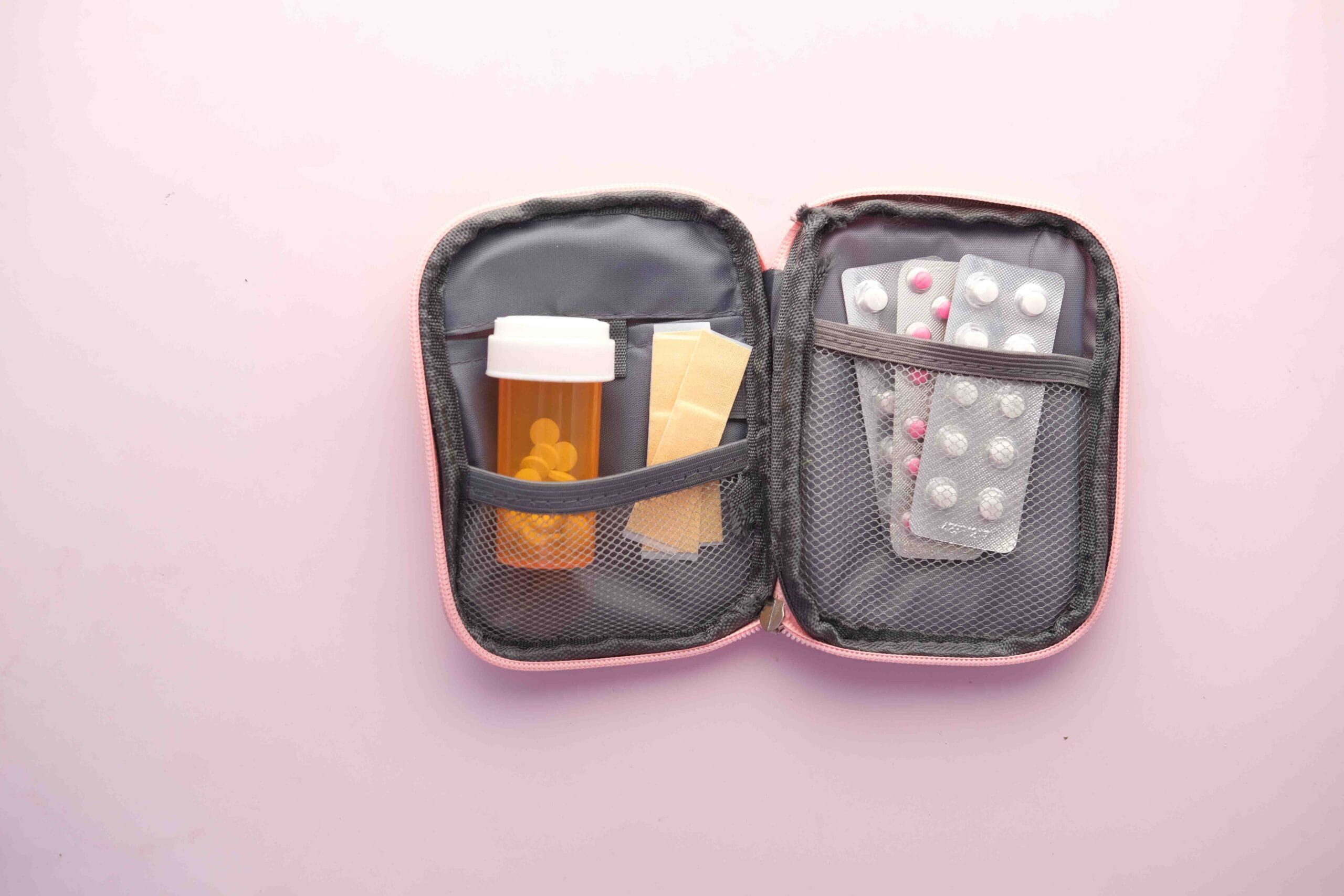
Read: Prescription Bottle Travel Bag, a padded bag with separate pockets designed to hold prescription bottles in their original packaging, so labels stay visible and medication stays together in your carry-on.
Prescriptions and a Doctor’s Letter
Carry a copy of your prescription
The dosage on the prescription should match the dosage on the packaging exactly, since a mismatch can raise questions at a border.
A letter from your doctor
Smartraveller (Australian government website) advises carrying a letter from your doctor stating that the medicine is for your personal medical use. A useful letter lists each medication by generic name, the dose, the condition it treats, and any devices you carry. See our guide on Doctor’s Letters: What They Should Say for what to include.
A letter supports the rules, it does not replace them
A doctor’s letter helps show that a medicine is yours, but it does not make a prohibited medicine legal in a country that bans it.
How Much to Carry
There are two pressures here, and they pull in opposite directions. Carrying extra medication protects you against delays and lost luggage. But many countries limit how much medication a visitor can bring for personal use, and the limit can vary by country and by medicine.
Match quantity to your trip
Carry enough for the trip plus a sensible buffer, and keep the quantity consistent with the dates on your itinerary and your prescription. A supply far larger than a trip requires can attract questions.
Get enough supply in advance
Ask your doctor and pharmacist early about arranging enough medication for the whole trip, since standard dispensing quantities can cover less time than a long trip.
Check the destination’s limit
Where a country sets a maximum for personal-use quantities, check it before you go. Australia, the United States and the United Kingdom all use roughly a three-month supply as a reference point in their guidance, but the details and legal basis differ, so confirm the rules for your specific medicine and route.
Controlled Medicines
Some medications are controlled or restricted, and these need extra care. This can include certain strong pain medicines, some ADHD medications, and some sleep and anxiety medicines.
Leaving Australia
The Office of Drug Control (ODC) states that permission is required to import or export controlled substances, and it publishes traveller guidance for people carrying prescription medicines out of Australia. Check the ODC’s traveller information for your specific medication before you go.
The destination country’s rules apply too
Some medicines that are legal to prescribe in Australia are controlled or banned elsewhere. For example, Japan prohibits some medications that are common in other countries, even with a valid prescription. Contact the embassy or consulate of your destination, and of any country you transit through, to confirm whether your medication is permitted. See our guide on Medications That Are Restricted or Banned Overseas for more detail.
Medicinal cannabis needs specific checking
Medicinal cannabis prescribed in Australia can be considered an illegal or controlled substance overseas. Check the rules for every country on your route well ahead of travel, including any transit stops.
Taking Medication Into and Out of the United States
Entering the US
US Customs and Border Protection (CBP) advises visitors to carry medication in its original container with the describer’s instructions on the label, along with a valid prescription or a doctor’s note written in English. Travellers should bring no more than personal use quantities, and CBP’s rule of thumb is no more than a 90-day supply. Medicines containing potentially addictive ingredients, such as some strong pain relievers, tranquillisers, sleeping tablets, antidepressants and stimulants, should be declared to a CBP officer, carried in their original containers, and accompanied by a prescription or a written statement from the prescribing doctor. A medicine not approved by the Food and Drug Administration (FDA) can be confiscated on arrival even if a doctor overseas prescribed it, so a product that is routine in Australia may not be allowed in. Check your specific medication with CBP before you fly. If you connect through a US airport on the way to another destination, the same rules can apply even on a short layover.
At US airport security
The Transportation Security Administration (TSA) allows medically necessary liquids, gels and aerosols above the standard 3.4 ounce (100 ml) limit in reasonable quantities, but you must tell the officer before screening begins and place them in a separate bin, along with related items such as syringes and freezer packs. Solid medication is screened as well. TSA recommends clear labelling but does not require it, and state laws on prescription labelling can differ, so keeping medication in its original labelled packaging remains the safest approach.
Leaving the US and returning to Australia
When you leave the US, the rules that matter are those of the country you are heading to, so check them again if you are continuing to another destination. On the return to Australia, up to a three-month supply of most medicines can generally be brought in for personal use, while restricted and controlled medicines are handled separately through the Office of Drug Control. Keep any medication dispensed in the US in its labelled packaging, and keep the paperwork with it.
Taking Medication Into and Out of the United Kingdom
Entering and leaving the UK
The UK Home Office treats medicines that contain controlled drugs differently from other medicines. Under its personal import policy, a traveller can carry up to a three-month supply of medicines containing controlled drugs in schedules 2 to 4 (part I) without a licence, as long as the medicine was lawfully prescribed and dispensed to them in their country of habitual residence and is carried on their person when they enter or leave the UK. Medicines listed in schedule 4 (part II) and schedule 5 are also covered. Controlled drugs include medicines such as codeine, morphine, diazepam and methylphenidate (Ritalin), and your doctor or pharmacist can confirm whether your medication contains one.
The Home Office recommends carrying a letter from the prescribing doctor, to be shown at the border if asked. It should include your name, each medicine with its dose, strength and frequency, and the describer’s signature and professional registration details. Your travel dates and the quantities listed should make it clear that you are not carrying more than a three-month supply. Anyone travelling for three months or more, or carrying more than a three-month supply, should contact the Home Office’s Drugs and Firearms Licensing Unit about whether a personal licence is needed, and should do this well ahead of travel, since UK travel health guidance suggests applying at least 10 days before departure. For medicines that do not contain controlled drugs, check the importing rules published by the Medicines and Health products Regulatory Agency (MHRA).
Do not post medication ahead
Medicines containing controlled drugs cannot be posted to you from overseas, and excessive quantities brought into the UK can be seized. If a trip runs longer than planned, the Home Office advises obtaining further supplies through a UK clinician rather than trying to have more sent or carried.
At UK airport security
UK hand luggage rules allow medicine in containers larger than 100 ml when it is essential for your journey, but you should carry supporting documentation from a medical professional, such as a letter from your doctor or a copy of your prescription.
Returning to Australia
The same Australian rules apply on the way home as after any overseas trip: up to a three-month supply of most medicines can generally be brought in for personal use, and controlled medicines are handled separately through the Office of Drug Control.
Keeping Your Medication Safe on the Journey
Carry it in your hand luggage
Keep medication with you rather than in checked luggage, where it can be delayed, lost, or exposed to temperature extremes. See our guide on Keeping Medication at the Right Temperature for medication with storage requirements.
Do not keep everything in one place
If all your medication is in a single bag and that bag is lost or stolen, you could be left without any. Ask your pharmacist whether your supply can be dispensed in separately labelled packs so you can divide it between bags.
Transit countries count
The rules of any country you pass through can apply, even on a short layover. Check each stop, not just your final destination.
Airport Security and Liquid Medication
Medically necessary liquid medication is generally permitted above the standard liquid limit through airport security, but it usually needs to be declared, and supporting documentation makes the process smoother. Rules vary by country and airport, so check the requirements of your departure airport and any airport you connect through. For flights from Australia, TravelSECURE publishes the restrictions and exemptions for liquids, aerosols and gels.
Do Not Buy Medication Overseas Without a Prescription
Never buy or use prescription medicine overseas without a valid prescription and medical advice. Packaging may look familiar while the strength and active ingredients differ from country to country, and counterfeit products are a real risk. If you run out or lose your medication, see our guide on What to Do If You Run Out or Lose Medication Overseas.
Insurance and Lost Medication
Most travel insurers do not cover the cost of replacing prescription medication, including when a bag is lost or stolen with medication inside, or when you are hospitalised and need a prescription medicine. If this matters to you, check the policy wording carefully and ask about specific cover. Read our Travel Insurance and Pre-Existing Conditions guide for what to check before you buy.
Before You Travel
Speak to your doctor early
Tell them your destination and dates. They can help you work out how to take your medication legally, or suggest an alternative that is allowed where you are going.
Check your destination and transit countries
Look up the rules for every country on your route, not just where you are staying.
Assemble your paperwork
Original packaging, a copy of your prescription, a doctor’s letter, and a list of generic names, all kept with your medication in your carry-on.
Check the name and dates
Confirm that your name on the label matches your passport, and that the quantity makes sense for your trip.
FAQs
Do I need to keep my medication in its original packaging when I travel?
Yes. The pharmacy label is the simplest evidence that a medicine was prescribed to you, and authorities overseas may ask for proof. Avoid transferring medication into an unlabelled pill organiser.
Do I need a doctor’s letter to travel with prescription medication?
It is strongly recommended. Smartraveller advises carrying a letter stating that the medicine is for your personal medical use, along with a copy of your prescription.
Can I take a large supply of medication overseas?
Many countries limit the quantity of medication a visitor can bring for personal use, and the limit varies by country and by medicine. Check your destination’s rules and keep the quantity consistent with the length of your trip.
Can I take any Australian prescription medication overseas?
No. Some medications that are legal in Australia are controlled or prohibited in other countries, even with a valid prescription. Check the destination and any transit countries before you travel.
Do controlled medicines need special permission?
They can. For example, in Australia, permission is required to import or export controlled substances, so check its traveller guidance for your specific medication before you go.
How much medication can I bring into the United States?
CBP advises bringing no more than personal use quantities, with a rule of thumb of no more than a 90-day supply, in the original container and with a prescription or doctor’s note written in English. Medicines containing potentially addictive ingredients should be declared to a CBP officer.
Can I bring controlled medication into the United Kingdom?
Often yes. The Home Office personal import policy covers up to a three-month supply of many controlled medicines that were lawfully prescribed to you, carried on your person, and supported by a letter from your prescriber. Larger quantities or longer trips may need a personal licence.
Should I put medication in my checked luggage?
No. Keep it in your hand luggage so it stays with you and is protected from delay, loss, and temperature extremes.
Will travel insurance replace my medication if it is lost?
Often not. Most insurers do not cover the cost of prescription medication, so check your policy wording carefully.
Final Thoughts
Carrying medication legally comes down to preparation: keeping medicine in its original labelled packaging, carrying a prescription and a doctor’s letter, matching quantity to your trip and your destination’s rules, and checking every country on your route before you travel. The United States and the United Kingdom both have specific guidance for visitors, particularly for controlled medicines, and a doctor’s letter can support your case but cannot make a banned medicine legal.
A note on what this is: Practical travel guidance, not medical or legal advice. Always confirm the current rules for your medication and destination before you travel.
For more on getting your medication through a trip, read our guides on medications that are restricted or banned overseas and what to do if you run out or lose medication overseas.